What is Freemasonry
A school of life, not a dogma
Men of very different backgrounds meet as equals to work with symbols and questions, not dogmas.
Freemasonry is an initiatic, traditional and fraternal order devoted to the moral and intellectual improvement of the individual.
It is not a subject learned in a few months, nor a networking club, nor a closed creed. It is a method for working upon oneself, among brethren of different beliefs and backgrounds, through the symbolic language of the ancient builders.
The roots of the Craft
From the stone yard to the lodge
Freemasonry grew out of the medieval guilds of stonemasons and builders. The lodge was the workshop beside the building site: there the trade was passed on, the rules of the guild were kept, and a fellow arriving from afar was recognised.
In the seventeenth and eighteenth centuries, men with no connection to stone began to join. The tool became a symbol and the work became the building of oneself: operative Masonry gave way to speculative. From it came the Grand Lodges, sovereign and bound together by mutual recognition.

A peculiar system of morality, veiled in allegory and illustrated by symbols.
The language
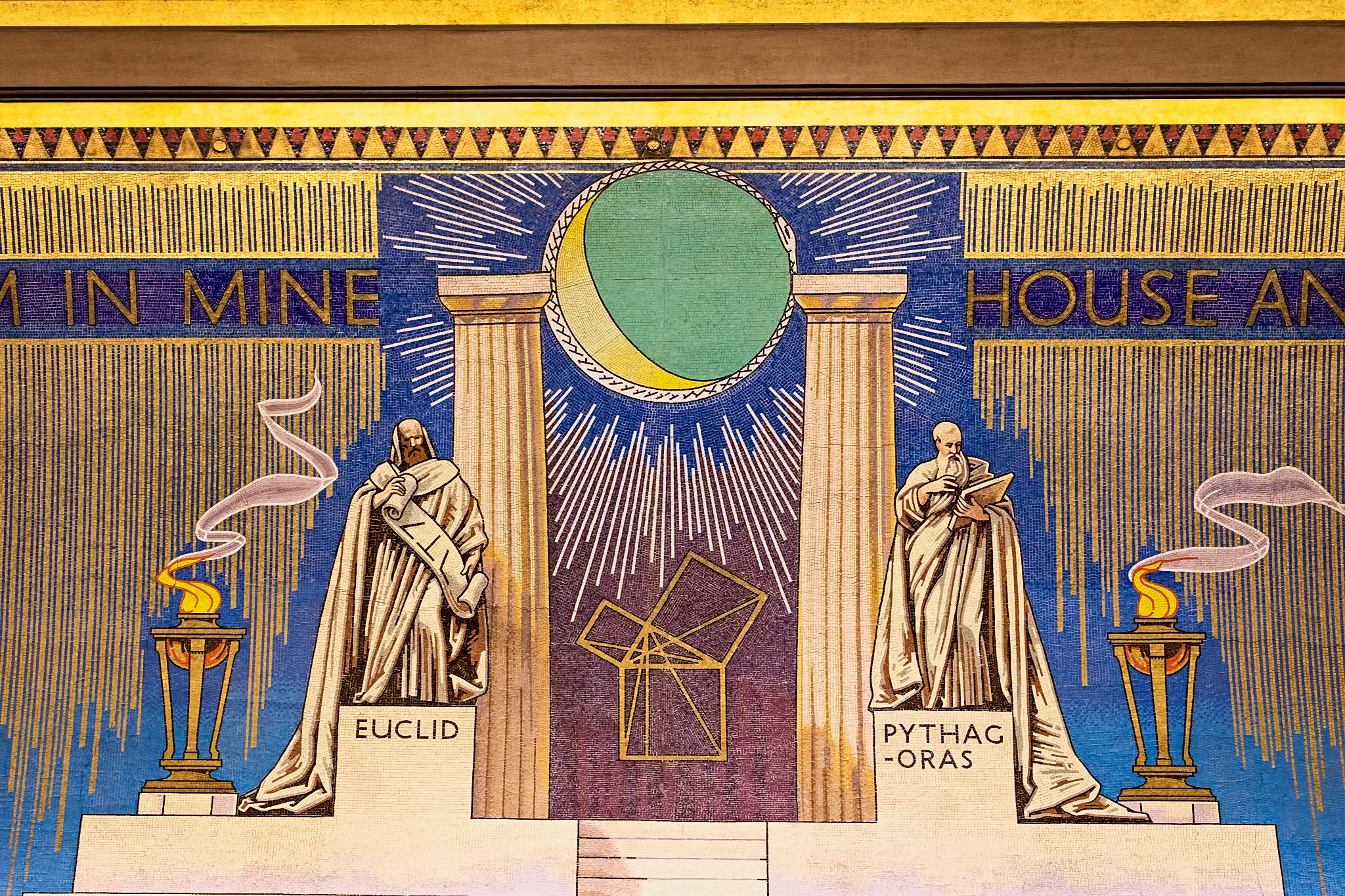
The language we have used for centuries
None of these figures is an ornament. Each one says something, and whoever learns to read them begins to see the world differently.
A secret society?
No, we are a society with secrets.
The difference matters: what we call «secrets» are certain ways of recognising one another between brethren, and they appear in a thousand books.
The real secret is another, and it is not kept by prohibition: it is an inner transformation that will not fit in a sentence. Nor is it a sect: hard to get into, very easy to leave.
What we cannot tell you is not because it is forbidden, but because it is not information: it is an experience.
Our principles
Four pillars on which it is built
Four demands that are not recited: they are practised every day, within the Lodge and beyond it.
Integrity
The squared stone. The one that sits plumb and carries the courses above: without a life of one piece, nothing raised upon it holds.
Fraternity
The mortar. What turns loose stones into a single wall; without it each brother would be a scattered block, not part of a work.
Respect
The level. The course laid flat so that no stone crushes another: every difference finds its place without breaking the whole.
Service
The keystone. The reason the wall is raised at all: the building does not close upon itself, it shelters others.
The three degrees
An inner path
The ancient hierarchy of the building trades has been preserved as a ladder of symbolic degrees. Each degree is not a rank but a stage of maturation.
-

First degree
Apprentice
Plain white apron
The entry into the work. The apprentice learns to know himself, to listen and to dress the rough stone. It is the time of observation and humility.
-

Second degree
Fellow
Two sky-blue rosettes
The time of study and of deepening. The fellow broadens his view, works with more tools and begins to take full part in the work.
-
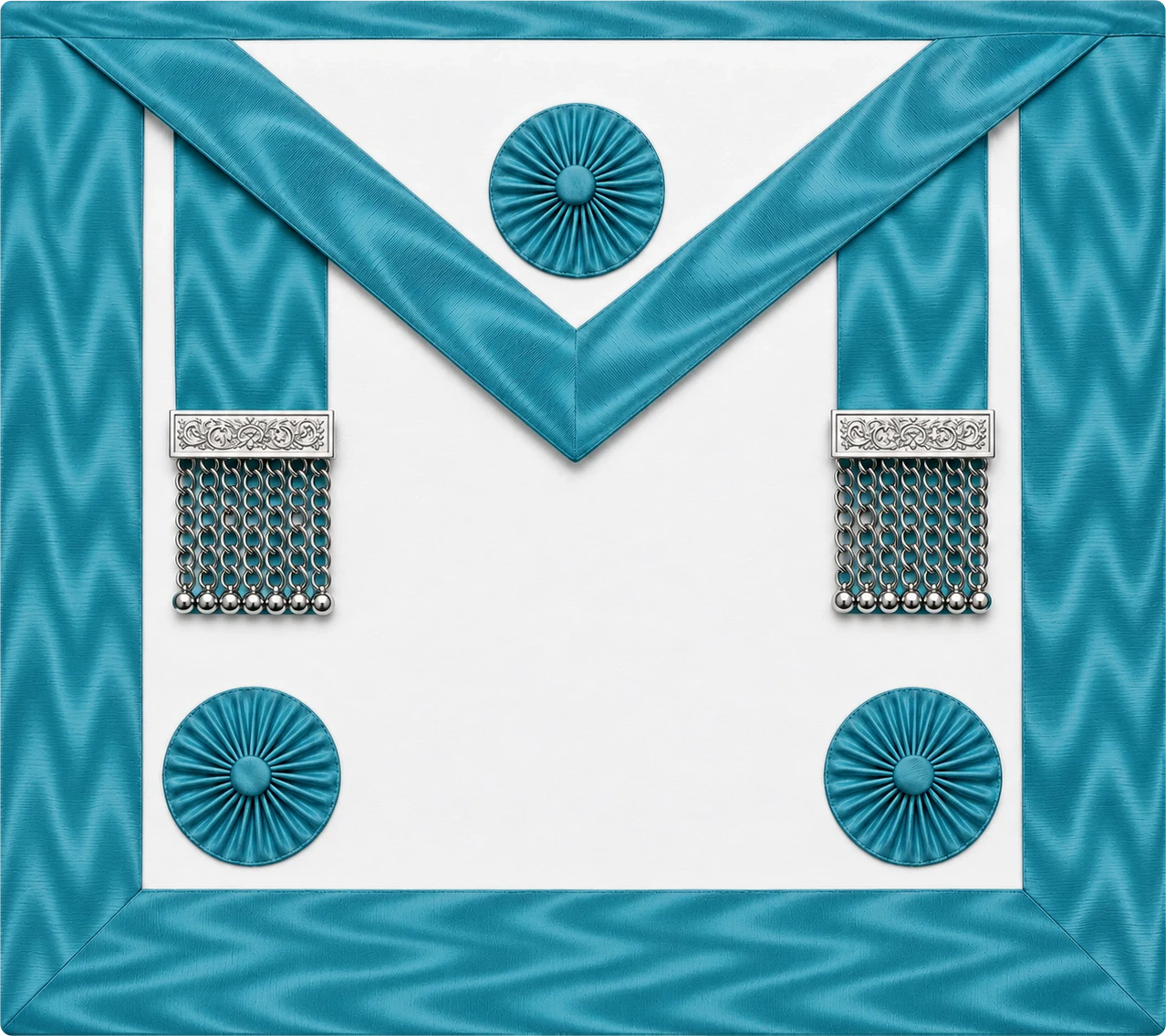
Third degree
Master
Sky-blue border and three rosettes
The fullness of Masonic work and the responsibility of transmission. The master watches over the tradition and guides those who begin the path.
What we do
The life of the Lodge

Freemasonry is not studied: it is practised. Nine lodges meet regularly, as a rule once a month, in a session we call a tenida. Around it everything else is ordered.
-
The tenida
The working meeting. A ritual, sober order, with nothing unsettling, is the heart of it all.
-
The papers
A school of thought: each brother studies, writes and presents, and what one learns ends up serving all.
-
Instruction
No one advances alone. The more seasoned brothers guide the newcomers, without haste or examinations.
-
Brotherhood
The bond that unites the brethren: trust, mutual aid and sincere affection that does not stop at the temple door.
-
Beneficence
Beyond the doors, discreet charity is a constant attitude, not an occasional gesture.
-
Equals in the lodge
Religion and politics stay at the door, so that what unites us fits inside. You are asked once whether you believe in a Creative Principle, and never which.
The badge
The badge a man earns
[…] A badge more ancient than the Golden Fleece […] more honourable than the Order of the Garter […] From the initiation ritual · Emulation Working
The Mason wears an apron. It is neither a uniform nor a decoration: it is the stonemason's leather apron, the one that protected the man who worked the stone. In girding it on, one remembers that he has come to work, not to be seen.
Hence its honour: it is neither inherited nor bought, but bestowed, and is worth only what one does while it is worn. A piece of white leather that says more of a man than any title.
Go deeper
Continue discovering the Order
From stone to thought
Six centuries of history: from the stonemason to Freemasonry today.
The historical journey →
Our history
From the first Andorran lodges of 1994 and the consecration of the Grand Lodge of Andorra in 2000, to the present day.
History of the GLA →
Questions about Freemasonry
Cost, time, compatibility with work, family and your beliefs.
See the questions →
Become a Freemason
Begin with a conversation
Serious work on oneself, lived in fraternity and among equals. Open to men of good will, of any origin or belief, willing to hold themselves to a high standard. If it interests you, take the step and write to us.
Request a private conversation Come to an open lodge